Meaning in Plain English
The last straw is the final problem, burden, or annoyance that makes an already difficult situation impossible to tolerate. The event called the last straw may be minor on its own. It becomes decisive because it arrives after many earlier pressures have accumulated.
After months of missed deadlines, the incomplete report was the last straw.
The rent increase was the last straw, so we decided to move.
When the printer failed again ten minutes before the meeting, it was the last straw.
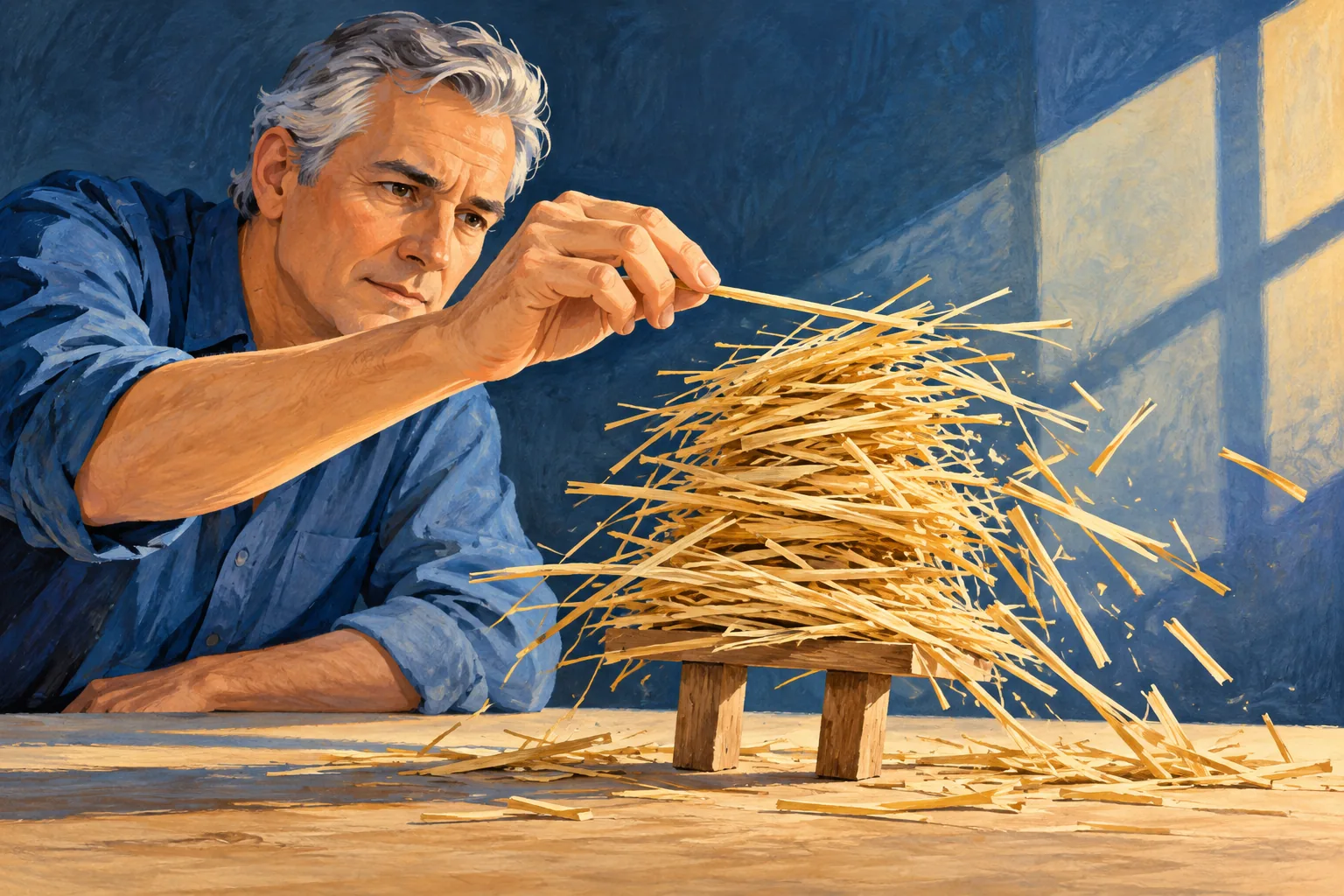
The fuller expression is the last straw that breaks the camel’s back. It imagines a heavily loaded animal receiving one more almost weightless piece of straw. The image does not blame the final piece for the whole burden. Instead, it marks the point at which the total load becomes unbearable. That distinction is central to the idiom: the last event is the trigger, while the accumulated strain is the cause.
What the Historical Record Shows
The short expression grew out of a longer proverb about a loaded camel. The sources do not name a single inventor, and their dates reflect different kinds of evidence. Etymonline’s entry for straw says that the camel image was in English use by 1755. It also quotes an April 1799 item from The Scots Magazine calling it an “Oriental proverb” and explaining that a small, ill-timed addition can overturn the whole load.
A separate survey by Phrase Finder reports the earliest exact camel-and-straw wording that its editor located in The Edinburgh Advertiser in May 1816: “straw upon straw was laid till the last straw broke the camel’s back.” That is not necessarily the first time anyone said or wrote the proverb. It is the earliest printed example that particular source reports finding.
The two accounts therefore answer slightly different questions. Etymonline dates the broader image, including variant wording, to 1755; Phrase Finder identifies its earliest located example close to the now-familiar wording in 1816. Etymonline then records the last straw used apart from the full proverb in 1836. This sequence supports the ordinary explanation that the shorter idiom is an abbreviated reference to the already familiar camel proverb.
The camel-and-straw image is documented in English before the standalone expression, which preserves the idea of a final small addition making a total burden intolerable. Merriam-Webster gives the modern sense as the final thing in a series of bad things that makes someone feel unable to continue accepting a situation.
Evidence, Image, and Origin Claims
The plausible literal image
The literal picture is straightforward. A camel can carry a load, each added piece of straw weighs very little, and a sufficiently burdened animal has a limit. The final straw is memorable precisely because it looks too small to matter. As a metaphor, the picture explains why a modest event can provoke a large response: the observer who notices only the final event may overlook the weight that was already there.
That logic is well supported by the documented forms of the proverb. It does not, however, identify a particular caravan, owner, storyteller, country, or moment when the metaphor was coined. The physical plausibility of an image is not the same thing as a documented origin story.
The older-proverb theory
One proposed line of development connects the camel saying with a proverb in which a final feather breaks a horse’s back. Phrase Finder’s older search found later horse-and-feather examples. However, Quote Investigator reproduces the saying in Thomas Fuller’s Gnomologia (1732), page 223, item 5120: “’Tis the last Feather, that breaks the Horse’s Back.” That predates the camel examples discussed here. The resemblance makes influence possible, but the evidence presented there does not establish that the camel version was copied from the horse version. It is safer to treat them as related burden-and-breaking images rather than to declare one the proven parent of the other.
Unsupported folklore
The saying is sometimes described as biblical, ancient, or specifically traceable to an unnamed Eastern or Arabic source. Those descriptions go beyond the evidence consulted here. Phrase Finder notes that the proverb sounds biblical but reports finding no last-straw saying in the Bible. Etymonline’s 1799 quotation labels it “Oriental,” but that historical label is not a citation to an original text in a particular language. The records support the proverb’s presence in English; they do not support a precise ancient author, scripture, or cultural birthplace.
How to Use the Phrase
The last straw is common in everyday speech, journalism, workplace discussion, and personal narratives. Its tone usually conveys frustration, exhaustion, or a firm decision after repeated trouble. It can describe the point at which someone complains, resigns, ends a relationship, changes a policy, or simply refuses to continue.
Use it when there is an implied series of burdens. The delayed payment was the last straw after weeks of unanswered messages.
tells the listener that the delay was not an isolated problem. By contrast, calling a completely unexpected single disaster “the last straw” may sound incomplete unless the earlier strain is already clear from context.
The phrase can refer to more than anger. A final expense may be the last straw for a strained budget; another equipment failure may be the last straw for an old production line; one more scheduling conflict may be the last straw for a plan. In each case, the essential idea is the same: an existing load reaches its limit.
Related forms have slightly different emphases. That was the straw that broke the camel’s back
makes the accumulated burden especially vivid. I’m clutching at straws
is a different idiom altogether: it means relying on weak hopes or unlikely solutions. Sharing the word straw does not make the expressions interchangeable.
Quick Questions
Does “the last straw” mean the worst problem?
No. It means the final added problem. It may be serious, but the metaphor often works best when that last event seems small compared with the response it produces.
Is “the final straw” also correct?
Yes. The final straw is a common variation with the same meaning. Both forms point back to the longer camel proverb.
Is the precise origin known?
The route from the documented camel proverb to the shortened English idiom is clear, but a first speaker and a single ultimate cultural source have not been established by the references consulted. The history is documented; a detailed invention story is not.
Sources and Further Reading
- Quote Investigator: The Early Bird Catcheth the Worme — reproduces the neighboring 1732 horse-and-feather proverb with a page and item number.
- Online Etymology Dictionary: “straw” — Dates the camel image to 1755, quotes a 1799 example, and records the standalone short form from 1836.
- Phrase Finder: “The Last Straw (that Broke the Camel’s Back)” — Gives the editor’s earliest located exact citation, discusses the horse-and-feather variant, and cautions against unsupported biblical and seventeenth-century claims.
- Merriam-Webster: “the last straw” — Provides the current dictionary definition and usage examples.