Meaning in Plain English
To jump on the bandwagon is to join a cause, trend, team, or product after it has become popular or appears likely to succeed. The phrase often suggests that popularity—not a long-held conviction—is driving the decision.
A person who begins supporting a winning team late in the season may be accused of jumping on the bandwagon. A company can jump on the bandwagon by copying a suddenly fashionable feature. The expression can be playful, but it can also criticize opportunism or unexamined conformity.
How to Use the Idiom
The most common construction is jump on the bandwagon. Get on, climb aboard, and be on the bandwagon also extend the same wagon image:
After the local club won eight games in a row, the whole city jumped on the bandwagon.
Several brands are getting on the refillable-packaging bandwagon.
She supported the proposal before it was popular, so she was not simply climbing aboard the bandwagon.
The object can be left unstated when the trend is already clear. Everyone is jumping on the bandwagon
means everyone is joining the movement under discussion. In more formal writing, adopted the popular position or followed the market trend may say the same thing more precisely.
The Literal Bandwagon
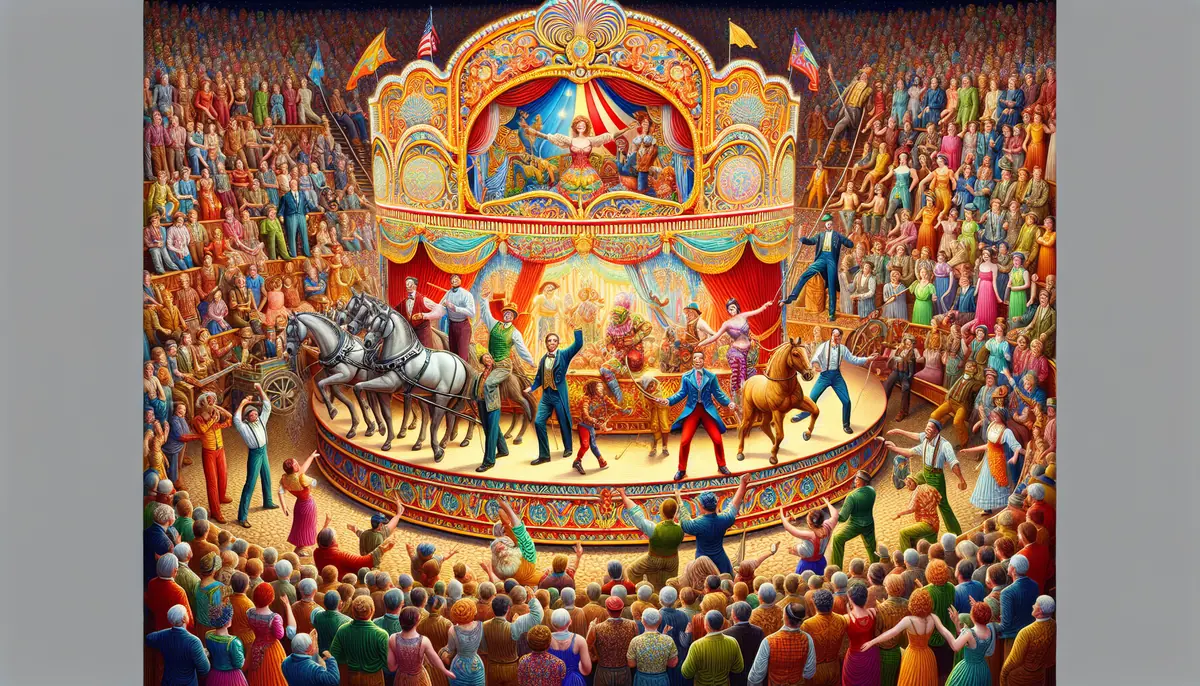
The metaphor began with a physical vehicle. Etymonline records bandwagon in American English from 1849 for a large wagon that carried a band in a circus procession. The moving musicians attracted attention, announced the show, and gave a parade a visible center.
P. T. Barnum used the term in his 1855 autobiography when describing the sale of transport while retaining horses and the band wagon
. That citation does not itself contain the modern idiom, but it confirms that the literal noun was familiar in mid-nineteenth-century show business.
The vehicle made a natural political prop. Music, decorations, crowds, and a candidate riding at the center could create the appearance of momentum. Once bandwagons became associated with successful campaigns, boarding one supplied an obvious image for attaching yourself to a likely winner.
From Political Parade to Figurative Phrase
The figurative sense developed in American political language. Etymonline dates the idea of attaching oneself to something likely to succeed to an 1899 use by Theodore Roosevelt. Phrase Finder reproduces Roosevelt’s wording: once his majority looked secure, people tumbled over each other to get aboard the band wagon.
The image carried criticism from the start. Those late supporters were not pictured as calmly reconsidering the evidence; they were scrambling toward the side that already looked victorious. That skeptical tone remains in modern phrases such as bandwagon fan, bandwagon support, and bandwagon marketing.
A popular retelling connects the political bandwagon to circus showman Dan Rice and presidential candidate Zachary Taylor in 1848. The story fits the general movement from circus publicity to campaign spectacle, but the surviving dictionary evidence is stronger for the literal wagon by 1849 and the figurative political wording by 1899 than for one decisive parade that created the idiom.
The Bandwagon Effect
The bandwagon effect is the broader tendency for a belief or behavior to become more attractive because many other people have adopted it. Visible popularity can generate still more popularity: a busy restaurant draws a crowd, a widely shared video gains further attention, or a leading candidate attracts late endorsements.
The psychological label and the everyday idiom overlap but are not identical. Jump on the bandwagon describes the person or organization joining. Bandwagon effect describes the social pattern that helps explain why people join. Neither phrase proves that the popular choice is bad; it questions whether popularity is being treated as evidence by itself.
Questions About the Phrase
Is jumping on the bandwagon always negative?
No. It can be teasing or neutral, especially when the trend is harmless. The phrase becomes more critical when it implies opportunism, weak conviction, or a refusal to examine the facts.
Did P. T. Barnum invent the phrase?
Barnum’s autobiography contains an early literal use of band wagon. It does not show him using the full modern idiom or prove that he coined it.
Why do people say “jump” on the bandwagon?
Jump makes the decision sound sudden and eager. It suggests someone boarding after the wagon is already moving rather than supporting the cause from the beginning.
Can a company jump on a bandwagon?
Yes. Businesses, political groups, publications, and institutions can all adopt a popular idea or style after its success becomes visible.
Sources and Further Reading
- Online Etymology Dictionary: “bandwagon” — dates for the literal noun and the figurative political sense.
- Phrase Finder: “jump on the bandwagon” — Barnum and Roosevelt citations.
- Political Dictionary: “bandwagon” — the phrase in campaign language.
- Wiktionary: “jump on the bandwagon” — forms, meaning, and usage.
- Wikipedia: “Bandwagon effect” — an overview of the social phenomenon and its applications.
- EC English: “Why do we say jump on the bandwagon?” — learner-focused explanation.
- Today I Found Out: phrase history — a secondary account of the circus and political background.
- Poem Analysis: “jump on the bandwagon” — meaning, examples, and historical summary.