Unveiling the Secrets: The Origin of ‘A Skeleton in the Closet’
Ever wondered why we call a shameful secret “a skeleton in the closet”? I mean, it’s pretty dramatic, right? We’re not talking about a dusty old photo album or a questionable fashion choice from the ’80s—we’re talking about actual human remains tucked away behind the winter coats. Buckle up, because the story behind this phrase is darker and more fascinating than you might expect.
The Grim Imagery Behind the Phrase
Let’s start with what this phrase actually means. When someone has a skeleton in the closet (or “skeleton in the cupboard” if you’re British), they’re hiding something seriously embarrassing—a secret that could absolutely wreck their reputation if it got out.

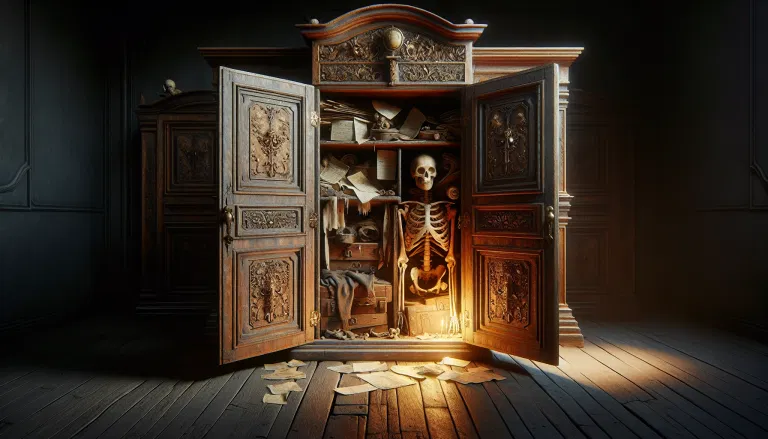
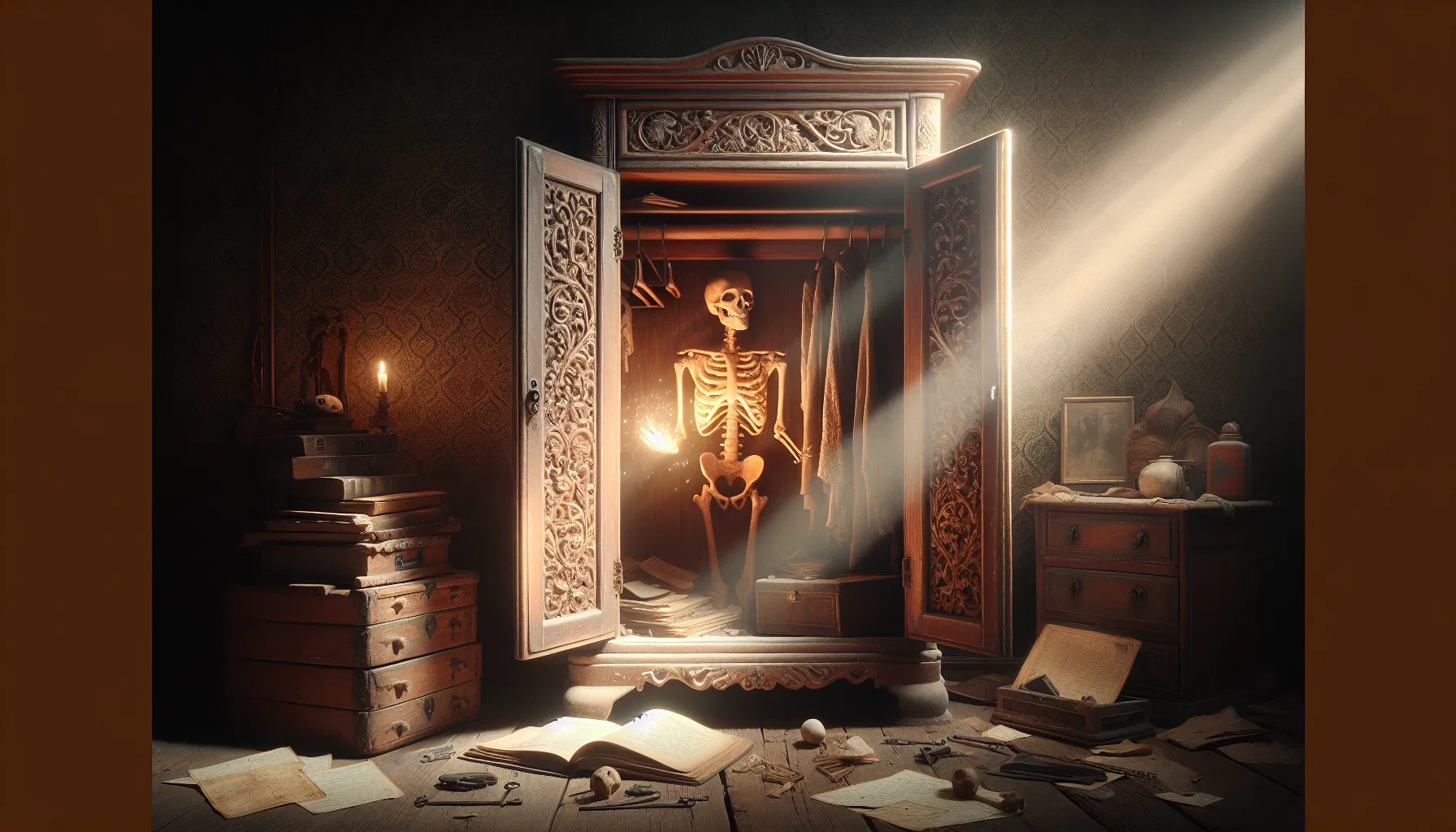
The imagery here is deliberately unsettling. We’re talking about a concealed human corpse that has decomposed to bones, literally hidden in your home. It’s not subtle! The phrase conjures up the idea of something grim and undisclosed lurking in the most domestic of spaces. Think past crimes, family scandals, or disgraceful events that someone desperately wants to keep under wraps.
The beauty—if we can call it that—of this metaphor is how it captures that constant anxiety of discovery. Your closet is right there in your house. Anyone could open it. The threat of exposure is always present, always looming.
Tracing the Phrase’s Roots
Now, grab a seat, because the origin story gets deliciously macabre. The phrase popped up in early 19th-century England, and the earliest known printed reference dates back to 1816 in a publication called The Eclectic Review. A writer named William Hendry Stowell used it figuratively to describe hereditary disease as a “skeleton”—already pretty grim, but it gets better.
Here’s where it gets really interesting: this phrase gained traction during the era of body snatchers. Yes, actual body snatchers! Before the 1832 Anatomy Act, medical professionals in England had a serious problem. They needed bodies to study anatomy, but legally obtaining corpses was nearly impossible. So what did they do? They turned to “resurrectionists”—people who dug up freshly buried bodies and sold them to doctors.
These doctors would then hide their illegally acquired skeletons in cupboards and closets to avoid public scrutiny. Imagine that! Your friendly neighborhood physician might literally have had a skeleton in his cupboard. The domestic imagery of a closet or cupboard wasn’t just metaphorical—it was based on an actual, horrifying practice that underscored the constant risk of discovery.
Literary Influence and Popularization
The phrase might have stayed a niche medical reference if not for one man: William Makepeace Thackeray. This literary giant took the phrase and ran with it, transforming it into the widespread metaphor we know today.
Thackeray first used variations like “a skeleton in every house” in a 1845 Punch article. He wasn’t done there, though. In his famous novel Vanity Fair (1848), he wrote about “closet-skeletons,” and later in The Newcomers (1854), he further cemented the phrase by referencing family skeletons.
What Thackeray did was brilliant: he took this dark, medical allusion and turned it into a commentary on Victorian society. Because let’s be honest—every respectable Victorian family had something to hide, whether it was financial ruin, illegitimate children, or scandalous affairs. Thackeray brought the idiom into literary prominence, making it the perfect shorthand for the hypocrisy lurking beneath polite society’s surface.
Variations and Endurance in Modern Language
Fast forward to today, and the phrase is still going strong—though with some regional flavor. In American English, we say “skeleton in the closet,” while our British friends prefer “skeleton in the cupboard.” Same concept, different furniture.
The phrase has evolved beyond its Victorian roots to describe any concealed embarrassing secret. We use it for everything:
- Personal scandals and indiscretions
- Family secrets passed down through generations
- Corporate cover-ups
- National histories, like colonialism or war crimes
- Unresolved mysteries where murder or culpability is implied
What’s remarkable is how the phrase has maintained its power. In our age of social media and constant exposure, the idea of a hidden skeleton feels almost quaint—yet we still use it constantly. It appears in idiom lists and media, often carrying implications of serious wrongdoing.
The phrase has even spawned related expressions, though none quite capture the same visceral imagery. “Elephant in the room” talks about obvious problems we ignore, but it doesn’t have that same sense of deliberate concealment and potential ruin.
Conclusion: The Lasting Impact of a Grim Metaphor
So there you have it—from literal body-snatching doctors to Thackeray’s literary genius to your everyday conversation about embarrassing secrets. “A skeleton in the closet” has traveled quite a journey, hasn’t it?
What makes this phrase endure is its perfect marriage of imagery and meaning. It’s visceral enough to make you uncomfortable, domestic enough to feel personal, and universal enough that everyone understands it immediately. We all have secrets. We all fear discovery. And we all know that feeling of something lurking just behind a closed door.
Next time you hear someone mention a skeleton in the closet, you’ll know you’re invoking a phrase with roots in grave-robbing, Victorian scandal, and the eternal human need to hide our most shameful truths. Pretty heavy for a simple idiom, right?
Stay curious, my friends!
Sources
The Phrase Finder – Skeleton in the Closet
Comprehensive exploration of the phrase’s meaning, origins dating back to 1816, and connections to the body-snatching era. Distinguishes between American “closet” and British “cupboard” variants.
Wikipedia – Skeleton in the Closet
Detailed entry defining the idiom, its evocative imagery of hidden corpses, early usage from 1816, and modern implications including related idioms.
English Explorations – Idiom of the Week: A Skeleton in the Closet
Academic breakdown of the idiom’s meaning related to shameful secrets and notes on Thackeray’s role in bringing the phrase into literary prominence in 1845.
Onestopenglish – Phrase of the Week: To Have a Skeleton in the Cupboard
Explanation of medical origins tied to pre-1832 Anatomy Act practices and highlights the British “cupboard” variant’s evolution from literal to figurative usage.
BookBrowse – A Skeleton in the Closet
Historical context on the phrase’s development in 19th-century England with specific quotes from Thackeray’s works in Punch, Vanity Fair, and The Newcomers.