Meaning in Plain English
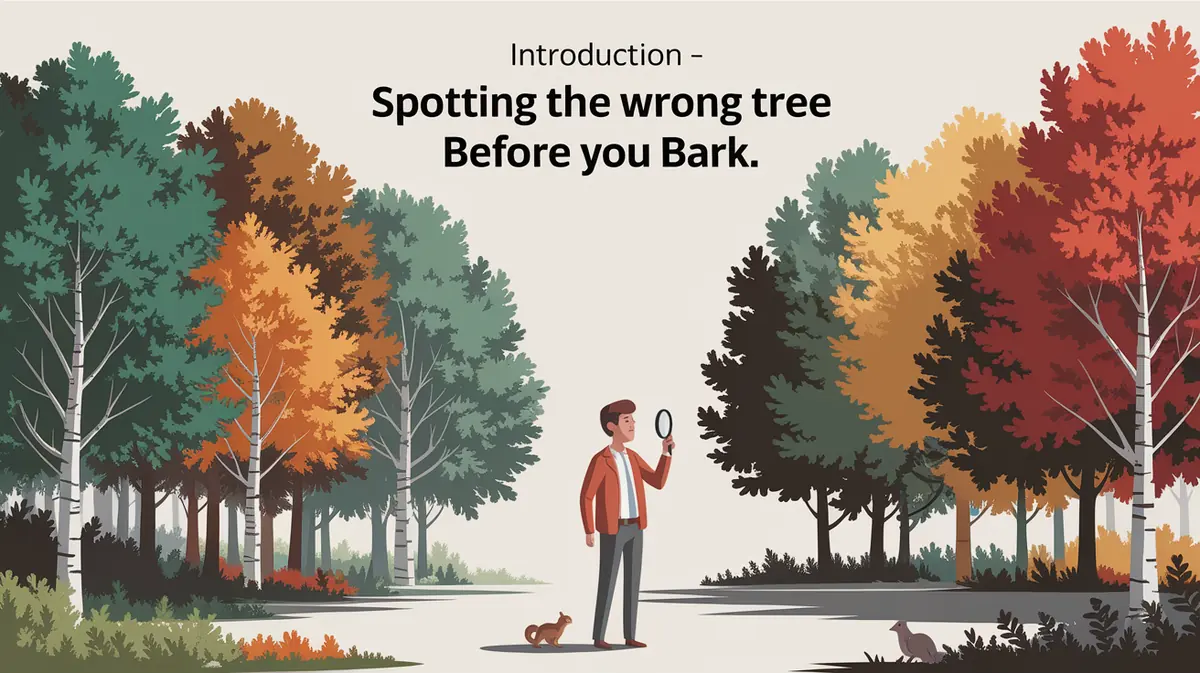
To bark up the wrong tree is to follow the wrong lead, blame the wrong person, or look for something in the wrong place. The effort is real; the target is wrong.
If you think I broke the vase, you’re barking up the wrong tree — it was the cat.
He blamed marketing for the drop in sales, but he was barking up the wrong tree: it’s a supply problem.
The police were barking up the wrong tree for months before the real suspect came forward.
The phrase can be blunt. It says the other person is loudly, confidently wrong — so it works best when the context allows direct correction.
The Hunting-Dog Image
The phrase comes from treeing dogs used in hunting. A dog tracks an animal, chases it up a tree, and barks at the base to tell the hunter where to look. If the animal has escaped to another tree, or the dog followed the wrong scent, the dog barks with total confidence at the wrong place. That image became a metaphor for mistaken certainty: the person may be energetic, loud, and persistent — but the target is wrong.
This background is documented, not invented. The earliest known printed use is from James Kirke Paulding’s novel Westward Ho! (1832), an American frontier novel — Phrase Finder records that citation. The frontier setting fits the image: raccoon hunting with dogs was a familiar American pastime, and the phrase’s early examples are American.
How to Use the Phrase
- Problem solving:
If you think the outage is the router’s fault, you’re barking up the wrong tree — the server is down.
- Blame:
She blamed the intern, but she was barking up the wrong tree.
- Persuasion:
You’re barking up the wrong tree if you think a discount will fix a trust problem.
For a softer tone, try I think we may be looking in the wrong place
or that may be the wrong lead
.
The Opposite Form: “Barking Up the Right Tree”
The positive variant — barking up the right tree — exists and is understood as the opposite, but it is much less idiomatic. Native speakers usually say on the right track or right on target instead. For a full discussion of that variant, see “Barking Up the Right Tree”: Meaning and the Variant Question.
Related Expressions
- Follow a false lead — pursue the wrong clue.
- Go down the wrong path — take a mistaken approach.
- On a wild goose chase — a futile search.
- Look in the wrong place — the literal paraphrase.
Quick Questions
Is the phrase American?
Yes — the earliest known printed use is American (1832), and the hunting-dog image fits American frontier life.
Does it always mean blame?
No. It covers false leads, bad assumptions, poor diagnoses, and ineffective strategies as well as blame.
Is it insulting?
It can be. The image suggests the person is loudly wrong. Use it carefully in formal or sensitive conversations.
Sources and Further Reading
- Phrase Finder: “barking up the wrong tree” — the 1832 Paulding citation and the hunting-dog explanation.
- Merriam-Webster: “bark up the wrong tree” — present-day definition.