

Why We Say ‘Read the Riot Act’: From 18th-Century Law to Modern Rebuke
A Verbal Sword – Why We ‘Read the Riot Act’
Ever wondered why your boss, your mum, or that exasperated schoolteacher once “read you the riot act” instead of, say, giving you a gentle tap on the wrist? Buckle up, because this phrase isn’t just colorful language — it’s a sturdy artifact from the age of powdered wigs, revolution, and very literal crowd control.
Today, it means delivering a stern warning — giving someone a royal dressing down, a tongue-lashing sharp enough to slice through your dignity — but once upon a time, it was the linguistic equivalent of the police flipping open their law book and saying: “You’ve got one hour to get out of here… or else.”
Tumult in Early 18th-Century Britain
Let’s paint the scene: Britain, 1714. The ink was barely dry on the paperwork installing King George I of Hanover. Not everyone, especially the Jacobite supporters, was thrilled. Riots were erupting over religion and politics, and the streets were hotbeds of civil disorder and unruly public assembly.
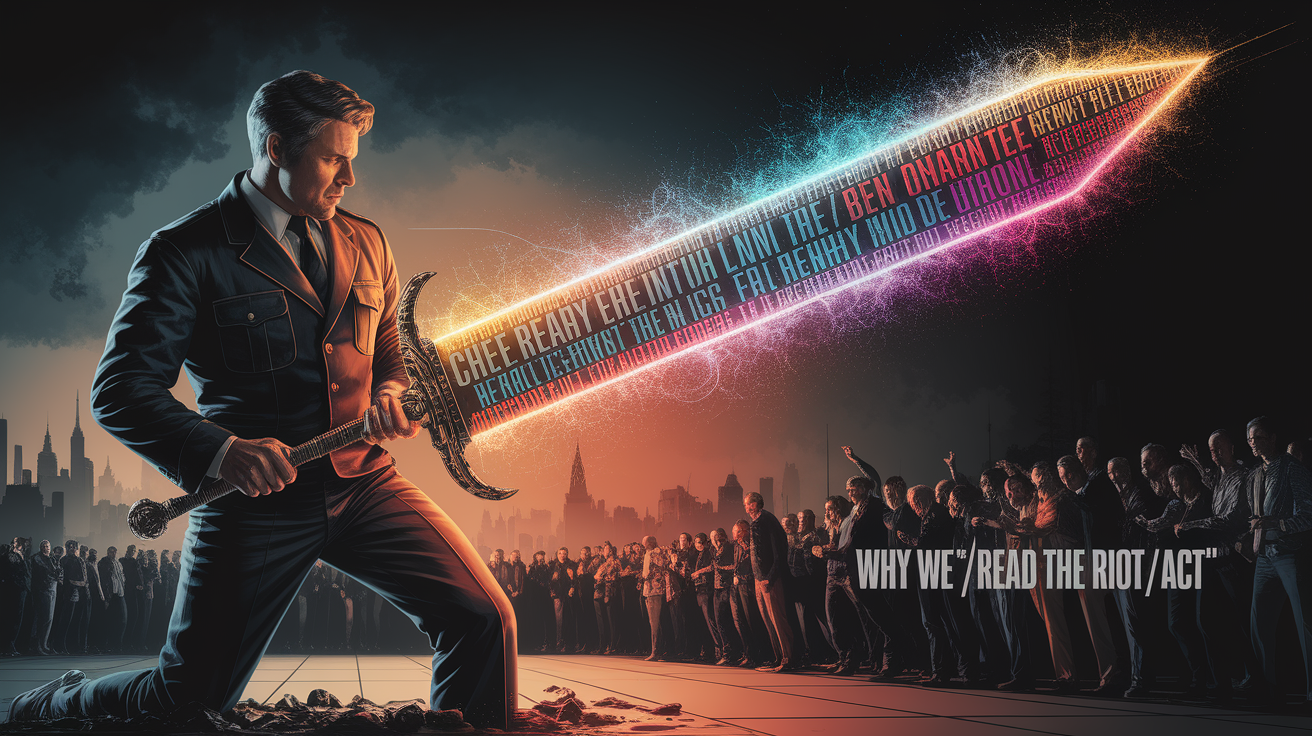
Parliament, sensing things were getting out of hand, decided to pass the Riot Act. It took effect on August 1, 1715 — a tool for law enforcement to tell an unlawful assembly that their party was officially over. And if the crowd didn’t disperse within sixty minutes? Well, they’d face arrest, harsh penalties, even potential execution. Think of it as the ultimate “you have been warned” in British law.
The Riot Act Unveiled
The Act wasn’t some vague suggestion; it came with a script. According to historical records, the text began: “Our sovereign Lord the King chargeth and commandeth all persons, being assembled, immediately to disperse themselves, and peaceably to depart…” The audience had one hour to comply before things could turn ugly.
This wasn’t just legal mumbo-jumbo — it formalized government authority to restore public order. It also limited military force; you couldn’t just send in cavalry without giving people a fair verbal shot at walking away.
Reading the Riot Act in Practice
Picture this: a local magistrate stands before a noisy crowd, voice steady, reading the proclamation in full. No skipping parts, no mumbling. It needed to be audible and official. Once read, the clock began ticking. The crowd had until the sixty-minute mark to scatter, or authorities could legally execute more forceful crowd control measures.
Interestingly, this procedure ensured that peaceful assemblies weren’t prematurely squashed — at least in theory. The reading acted like a verbal contract between authority and citizen: “We asked nicely. You refused. Now we act.”
A Dark Chapter – The Peterloo Massacre
Not every reading went down in a textbook fashion. On August 16, 1819, Manchester saw one of the most infamous uses of the Riot Act: the Peterloo Massacre. Citizens had gathered peacefully to demand voting rights, but the magistrates read the Riot Act anyway.
The crowd didn’t disperse quickly — maybe they didn’t hear, maybe they thought peace would prevail. The cavalry charged. Chaos erupted. At least 15 were killed and hundreds injured. It was a tragic reminder that wielding such legal authority could end in disaster when tempers and politics collided.
From Outlaw’s Warning to Office Scolding
Fast forward to today, and “reading the riot act” no longer requires powdered wigs or Parliament’s blessing. The phrase slipped into metaphor, meaning to lecture sternly, admonish strongly, or generally tell someone off in the most emphatic terms possible.
Parents read the riot act to misbehaving kids. Managers read it to employees who’ve missed every deadline since 2019. Friends might jokingly use it when you forget their birthday. The transformation from felony charge to idiomatic severe reprimand is fascinating — and proof that some legal relics have immortal flair.
- Synonyms today: give a tongue-lashing, lay down the law, give a dressing down, chastise severely, berate someone.
- Modern contexts: workplace discipline, domestic scolding, humorous exaggerations.
You can check dictionary definitions to see how neatly the expression’s meaning has been packaged for modern English.
Final Call – Why We Still ‘Read the Riot Act’
So next time someone “reads you the riot act,” remember — it’s not just a figure of speech about you forgetting to clean the kitchen. It’s a phrase with roots in 18th-century British law, civil unrest, and the delicate dance between order and freedom.
We keep it alive because, frankly, it’s punchy, dramatic, and useful. Whether in handling modern public order in a newsroom meeting or a dining table debate, it carries a sense of authority — even if no one’s actually facing hard labor afterward.
And there you have it — from riotous mobs to your living room. Next time you drop this phrase, you’ll wield it with the smug satisfaction of historical insight. Go forth and reprimand responsibly!
Sources
- Atlas Obscura – Overview of the original Riot Act, its purpose, and implementation in 18th-century Britain.
- History Extra – Detailed history of the Riot Act’s passage, sociopolitical context, and notable incidents like the Peterloo Massacre.
- Ward and Smith – Explanation of the procedural importance of the Riot Act’s warning before using force.
- YouTube – Video discussion on historical origins and modern meanings of the phrase.
- Wiktionary – Linguistic perspective on idiomatic usage of “read the riot act.”
- Dictionary.com – Current definition of the phrase in everyday English.


